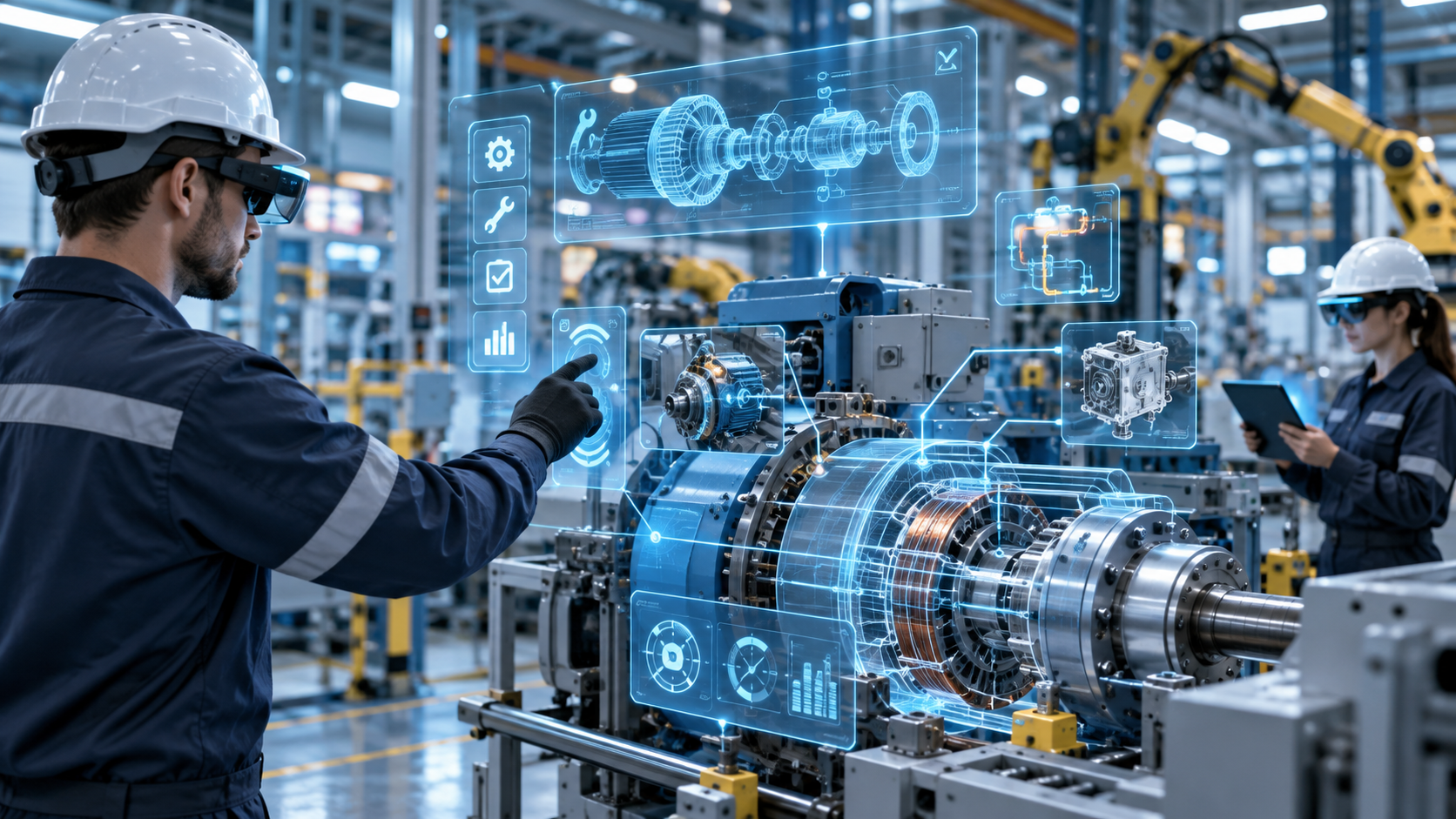
A new machine requires operator training, maintenance familiarisation and safety preparation. Training on live equipment consumes production time and may introduce risks. Enterprise AR/VR solutions offer an alternative: employees can practise procedures in simulations, explore virtual facilities and review technical information before working on site.
Enterprise AR/VR solutions involve the use of immersive digital environments and augmented visual information to assist in the training, interaction, operational planning and technical collaboration of industrial processes.
VR in Industry helps manufacturers and engineering teams practise complex tasks and prepare for real operations. VR supports immersive training, while AR provides contextual guidance alongside physical equipment. Neither replaces engineering controls nor hands-on competency checks.
What Are Enterprise AR/VR Solutions?
Enterprise AR/VR solutions support business processes rather than entertainment. Virtual Reality in Industry uses computer-generated environments where employees inspect models and practise tasks, often through a headset. Augmented reality (AR) overlays instructions or diagrams onto real surroundings through compatible devices.
VR suits emergency drills, machine familiarisation and layout reviews without occupying a live workstation. AR is more useful for equipment maintenance and guided assembly because technicians must see the physical machine. Together, they provide AR/VR solutions for businesses seeking better industrial training, technical visualisation and planning.
How Is VR in Industry Transforming Industrial Operations?
Essential knowledge is passed on through traditional manuals, videos and classroom sessions, but can't always reproduce the spatial and procedural requirements of a plant floor. VR in Industry introduces interactive learning: trainees make decisions, they take ordered steps and they observe the consequences in a controlled digital scenario.
Immersive models can also help the operations teams with pre-installation reviews, equipment access checks and remote engineer collaboration. The aim is to address an operational issue. Explore XRINK's AR/VR Services for Industrial Businesses for examples of these applications.
Key Industrial VR Applications and AR Use Cases
VR-Based Employee Training and Onboarding
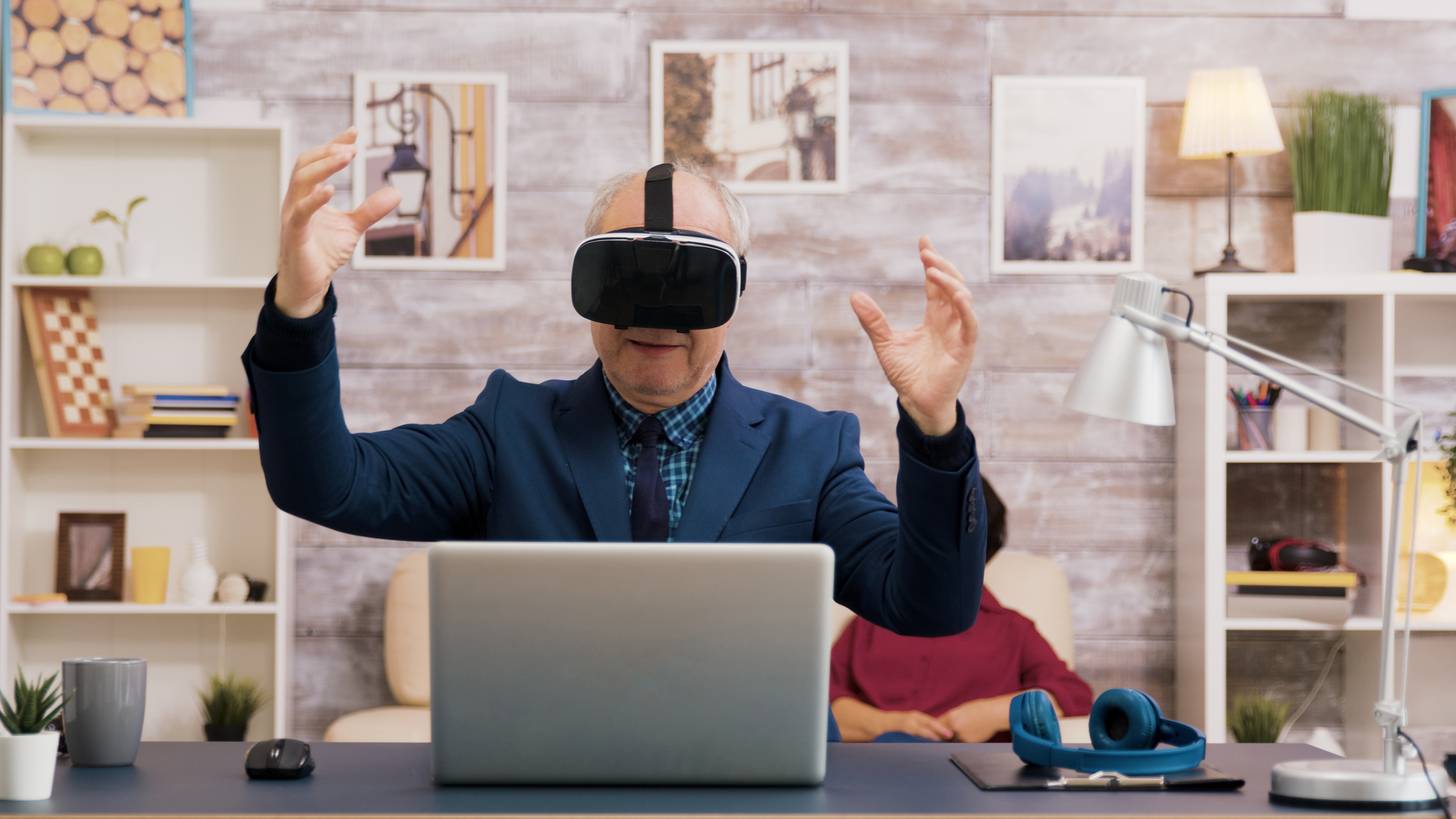
A new operator can initially familiarize him/herself with the components, operating sequence and common warnings within a virtual replica of a machine. A guided module may include a selection of the appropriate control, start-up process or response to a simulated fault.
Industrial VR training is especially pertinent when the equipment is costly, access is scarce or the procedures need to be taught across sites in a uniform manner. This should be followed up with supervised practical assessment. VR based technical skill development for industrial workers is also discussed by XRINK.
Industrial Safety Training and Hazard Simulations
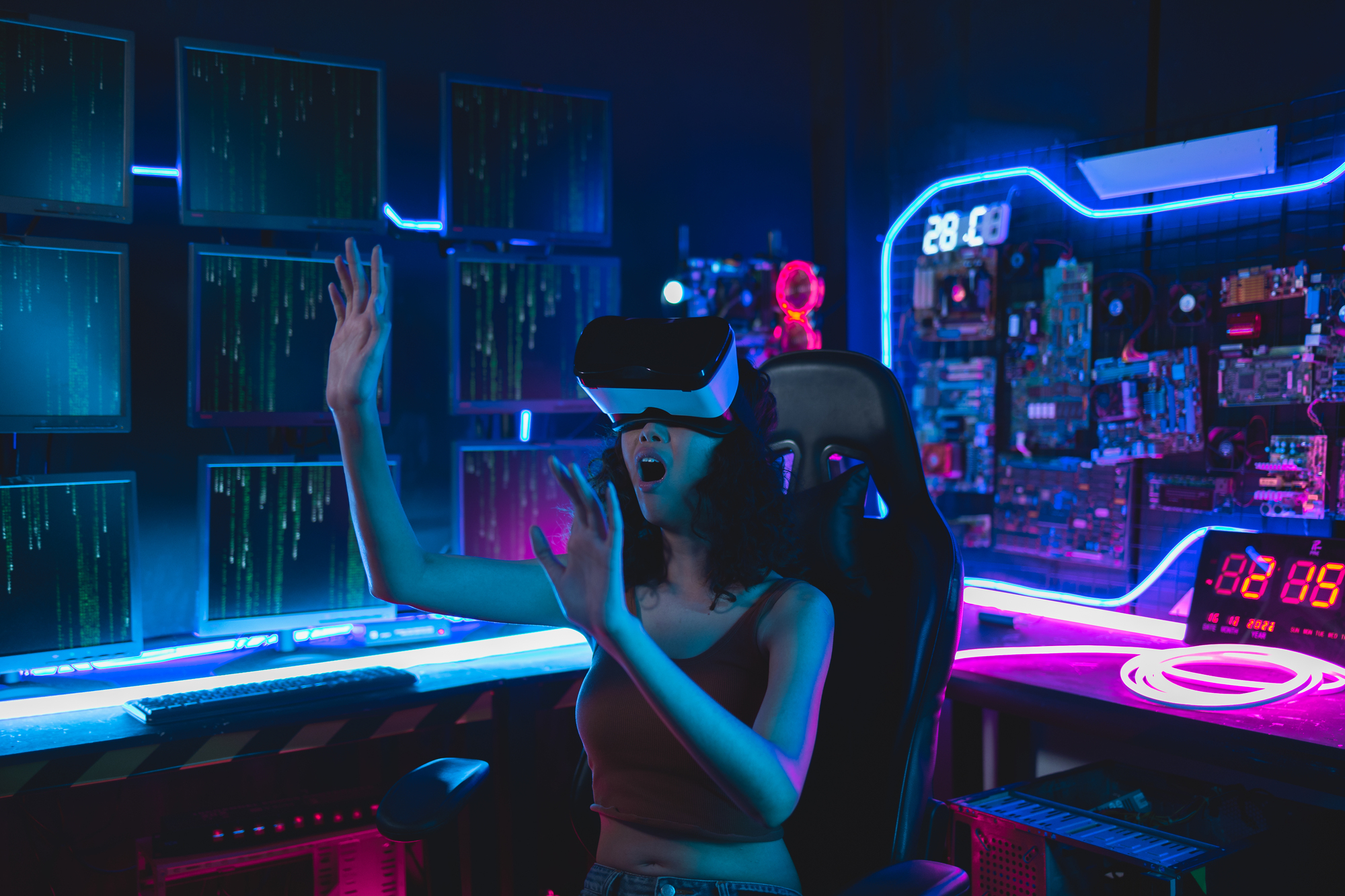
Sometimes it is hard to safely replicate fire response, unsafe access points, electrical hazards, and confined space procedures when conducting routine training. An exercise in VR can show a hazard, require the necessary response, and track whether or not the critical steps have been taken.
Trainees may for example recognize warning signs and choose a route of evacuation in a virtual production facility. These simulations are to aid in hazard identification, but are not a substitute for the mandated instruction, protective measures and emergency drills. Discover more about workplace safety training that is immersive.
VR in Manufacturing and Production Planning
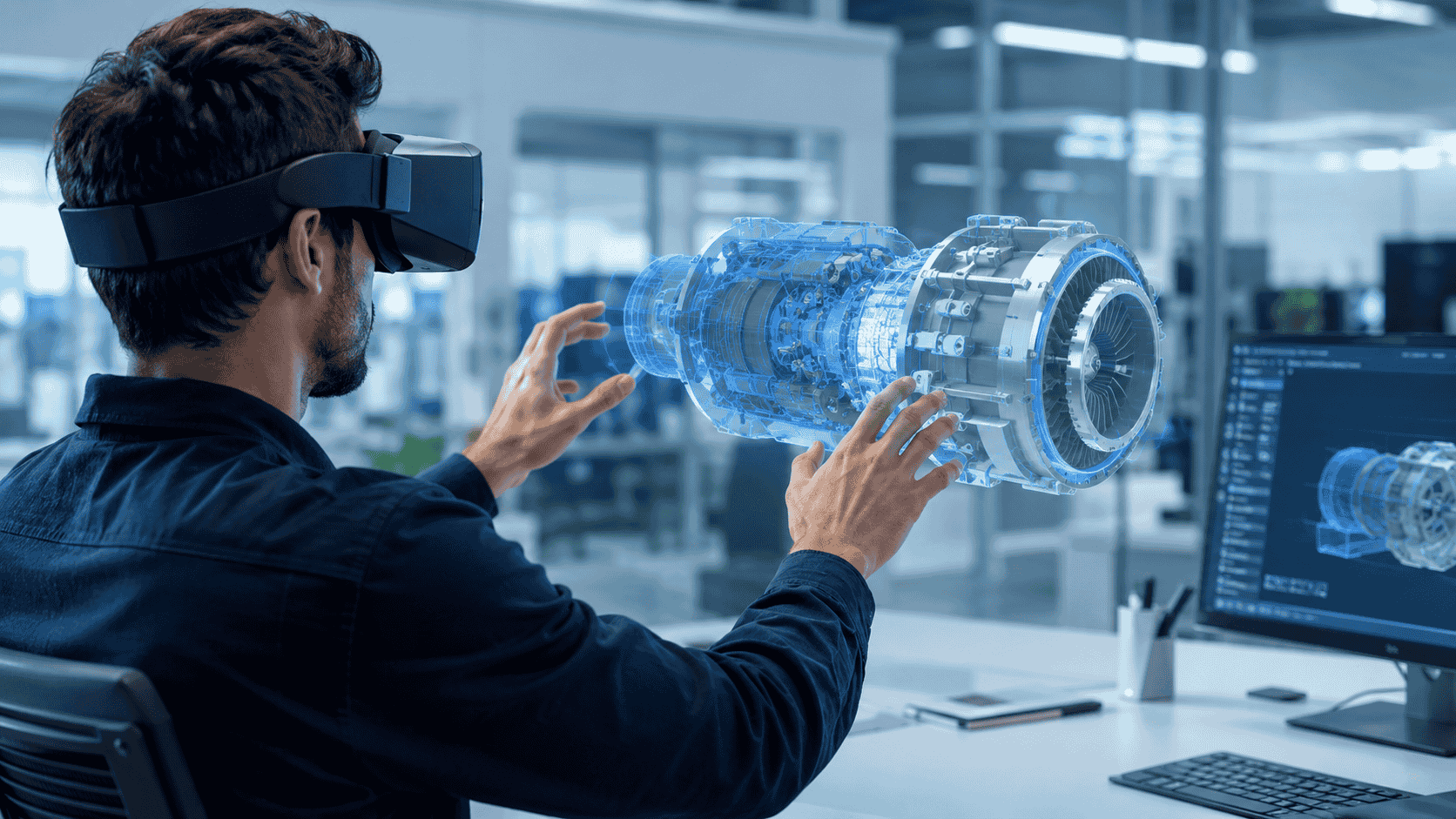
Virtual reality can be used in manufacturing settings to visualize and explore potential factory layouts, machine configurations and workstation designs in 3D environments. This is a way for teams to determine how equipment will be accessed, how the workspace will be used and layout issues without making physical changes.
VR in Manufacturing is therefore beneficial for design reviews and communication among production, maintenance and safety teams. The simulated results need to be verified with real dimensions, process constraints and standards.
Equipment Maintenance and Technical Training
VR allows maintenance personnel to rehearse dismantling procedures, locate parts, and plan for out-of-the-ordinary situations. The exercise can be done without putting a working machine into service.
In the real repair, AR might be the superior option: contextual diagrams and checklists can be displayed alongside the equipment when a technician is working. Both require up-to-date and accepted technical data. Lockout procedures and qualified supervision as appropriate still apply to safety critical tasks.
Virtual Prototyping and Product Design
Engineers designing industrial machinery, vehicles or complex assemblies can check out three-dimensional concepts before moving on to physical prototypes. VR enables reviewers to evaluate reach, visibility, access and overall spatial relationships from various angles.
Visual inspection alone cannot establish structural performance or manufacturing feasibility. Immersive design reviews should complement CAD verification, engineering calculations, relevant simulation tools and physical testing.
Immersive Facility Walkthroughs and Virtual Collaboration
A plant walkthrough can orient visitors or new employees to the plant with regard to plant entrance, operating zones and department locations prior to the site visit. Virtual tour technologies with 360° Virtual Tour Solutions may be an alternative to a full interactive simulation for documentation and orientation purposes.
Teams can also use a shared VR environment to view layouts and discuss design changes as a group, regardless of their location. VR collaboration for engineering teams is something XRINK examines in its article. When confidential engineering information is involved access permissions and control of model versions are relevant.
Key Benefits of VR in Industry
Benefits of VR in Industry depend on task suitability, realistic content and deployment quality. Well-designed simulations support consistent training, repeated practice of uncommon procedures and safer rehearsal of hazardous scenarios.
Industrial VR training enables repeatable practice, while keeping trainees safe from the risk of live equipment. Immersive reviews can also cut down on the need for physical training resources and help to explain complicated designs.
Significantly, increased learner engagement does not necessarily lead to a decrease in incidents or an increase in productivity. Those business results should be measured separately.
Understanding the ROI of Enterprise AR/VR Solutions
Return on investment (ROI) is a measure of the measurable advantages of an AR/VR programme against the total expense of implementing and operating the programme. An industrial VR project should start with a baseline, rather than an assumed savings percentage.
Documenting first, current training hours, time of instructors, equipment not available, travel costs, procedural mistakes, assessment results. Next, include the complete project cost: content development, 3D modelling, hardware, licensing, integration, employee support and future updates.
ROI (%) = [(Verified financial benefits − Total programme costs) ÷ Total programme costs] × 100
For instance, a reduction in the number of hours spent by instructors can be counted as a reduction in costs. Compare training costs before and after training (one-time and ongoing costs); report non-financial improvements separately.
Challenges of Implementing AR/VR in Industrial Environments
Practical limitations with immersive technology. A good simulation needs good models of the assets and often needs to be updated when there are changes in the machinery or procedures. Headsets should be appropriate for the work environment and take into account comfort, hygiene, accessibility and safe mobility.
IT teams must take into consideration connectivity, security and integration with existing systems. Other modes of training may be needed for headset discomfort. A focused pilot allows to know whether or not the solution mirrors real operational decisions.
How to Choose the Right Enterprise AR/VR Solution
Choose one of the problems that is expensive or hard to do: a dangerous training situation, a frequent assembly mistake, or a delay in layout approval. Don't choose technology before determining users, necessary interactions and evidence of success.
Research providers and compare them in terms of industrial experience, customisation, hardware compatibility, data protection and technical support. Ask for a demonstration with your equipment and identify means for measuring outcomes. Focus on solutions that fit within current workflow.
The Future of VR in Industry
In Industry, the future of VR could be the more complete integration of digital twins, industrial data visualisation and collaborative engineering tools. Reliability of information and proper technical integration are important for any benefit.
A connected digital twin needs updated data and validation – a static 3D walkthrough is not the same. Focusing on measurable operational value, not technology labels is a manufacturer's priority.
How XRINK Supports Industrial Immersive Experiences
XRINK’s expertise is in the field of immersive technology solutions for industrial training, 3D visualisation and virtual walkthroughs. Assess these experiences against workforce, also discussess Personalised AI Solutions. Any proposed implementation must be weighed against the intended use case and technical data and measurable outcomes available.
Conclusion
Enterprise AR/VR solutions can be used to train employees, check designs and collaborate effectively. VR in Industry is valuable when solutions are aligned with actual needs in the industry, have accurate content and provide measurable outcomes. Work with XRINK's industrial AR/VR services to find a proper use case to assess before scaling up.